
 Smart Bus Dispatching: How People Counters Are Revolutionizing Public Transit
Imagine standing at a bus stop on a rainy morning, shivering as you check your phone for the 10th time—your bus is 15 minutes late, and when it finally arrives, it’s so crowded you can barely squeeze on. On the other side of the city, a bus glides through empty streets, its seats mostly unoccupied, burning fuel for a route that’s barely used. This scenario is all too familiar in cities around the world, and it’s a symptom of a bigger problem: traditional bus dispatching, rooted in fixed schedules and guesswork, is no longer equipped to keep up with the dynamic needs of modern urban life.
But there’s a solution changing the game: bus people counters. These small, powerful devices are transforming how transit agencies manage their fleets, turning data into smarter, more efficient dispatching decisions. No longer do agencies have to rely on outdated timetables or manual passenger counts—people counters provide real-time, accurate data that bridges the gap between supply and demand, making public transit more reliable, cost-effective, and passenger-friendly.
The Problem with Traditional Bus Dispatching
For decades, bus dispatching has been a balancing act based on guesswork. Transit agencies create fixed schedules using historical ridership data (often months or years old) and adjust them manually based on driver feedback or passenger complaints. But urban transit is anything but static: rush-hour crowds fluctuate, events (concerts, sports games, festivals) create sudden surges, and weather or traffic jams throw even the most carefully planned schedules off track.
The result? Inefficiency at every turn. According to industry research, traditional dispatching leads to bus empty rates as high as 25%, while peak-hour buses often exceed 120% capacity. Passengers face long wait times (averaging 20 minutes or more during peaks) and overcrowded rides, driving many to choose private cars instead. For transit agencies, this means wasted fuel, higher operational costs, and lower passenger satisfaction—all while struggling to meet sustainability goals and urban mobility needs.
Worse, traditional methods like manual headcounts or ticket sales analysis are slow, error-prone, and outdated by the time the data is processed. A single missed count or delayed report can lead to poor dispatching decisions that ripple across an entire route.
How Bus People Counters Work: The Backbone of Smart Dispatching
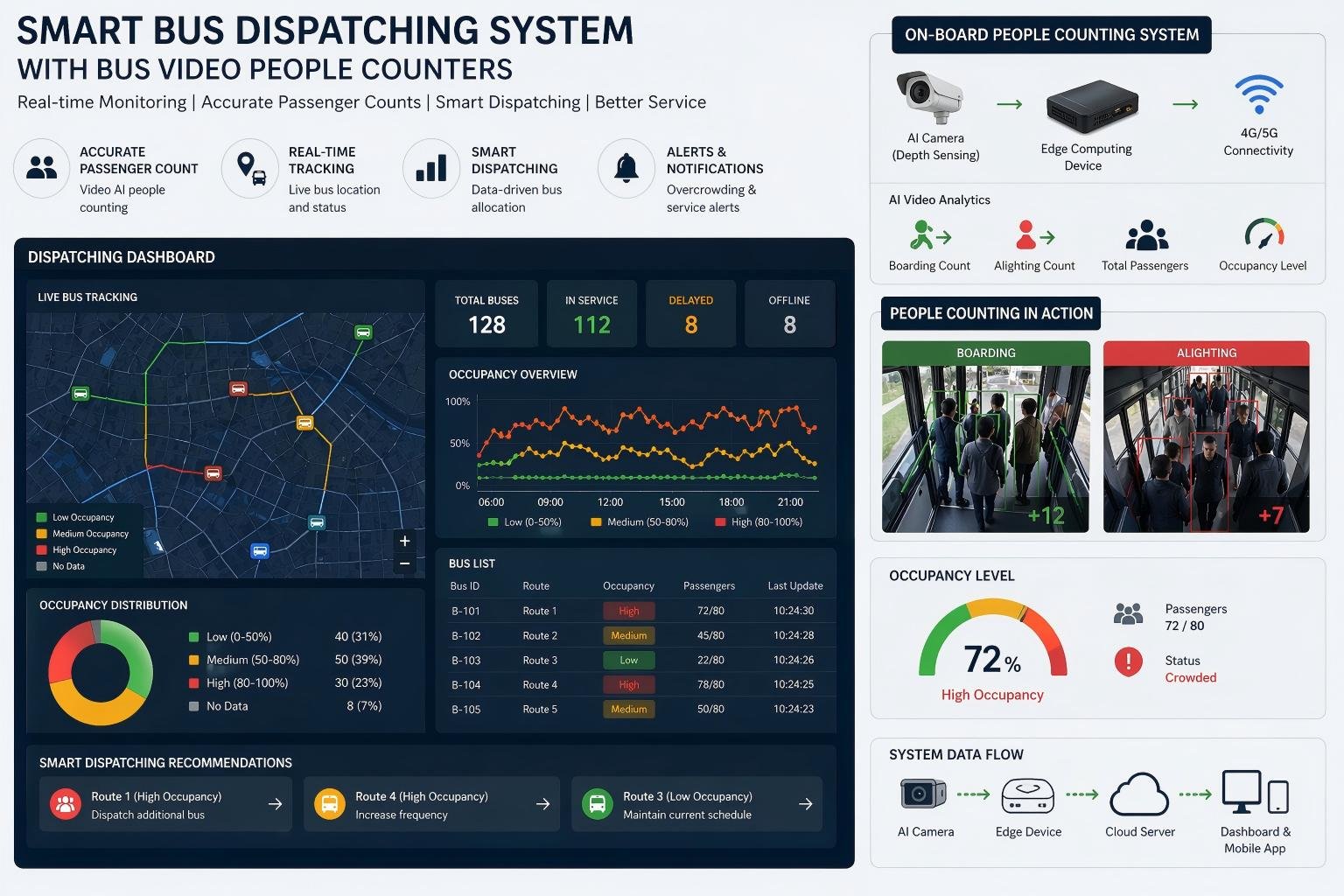
Bus people counters are the unsung heroes of smart transit. These devices—typically mounted above bus doors or on interior pillars—use advanced technology to track passenger numbers in real time, with accuracy rates exceeding 95% thanks to 3D stereoscopic video and AI-powered analytics. Unlike manual counts, they work seamlessly in all conditions, whether it’s bright sunlight, darkness, or crowded boarding moments.
The technology behind modern people counters is sophisticated yet straightforward:
-
3D Image Sensors & Stereo Vision: Binocular cameras capture depth information, allowing the system to distinguish between passengers entering and exiting, even when multiple people pass through the door at once. This eliminates duplicate counts from passengers who hesitate or step back, ensuring precision in complex environments.
-
AI & Machine Learning: Advanced algorithms analyze video feeds to track passenger movement, classify occupancy levels, and even predict future ridership based on historical patterns, weather, and events. This turns raw data into actionable insights.
-
Real-Time Data Sync: Count data is instantly transmitted to a central dispatching platform, where it’s integrated with other critical information—GPS location, traffic conditions, and vehicle status—to create a holistic view of fleet operations.
Some systems even integrate with platform-based counters, tracking the number of passengers waiting at stops to further refine dispatching decisions. The result is a constant flow of accurate, real-time data that eliminates the guesswork from dispatching.
Transforming Dispatching: What People Counters Enable
When paired with a smart dispatching system, people counters don’t just count passengers—they revolutionize how transit agencies operate. Here’s how:
1. Dynamic, Demand-Driven Scheduling
Gone are the days of fixed timetables. With real-time occupancy data, dispatching systems can automatically adjust bus intervals to match demand. If a bus on Route 5 is 80% full by the third stop, the system can send an extra bus to relieve overcrowding. If Route 12 is running empty during midday, intervals can be extended to reduce waste. This “on-the-fly” optimization ensures that buses are where they’re needed, when they’re needed.
For example, Singapore’s BusSG system—upgraded in 2024—uses real-time passenger data to adjust intervals, cutting peak-hour wait times by 35% and boosting on-time rate to 92%. Similarly, Shenzhen Bus Group, in partnership with Huawei Cloud, uses occupancy data to generate customized daily schedules in just 3 minutes, with buses arriving within 2 minutes of their predicted time 90% of the time.
2. Reduced Operational Costs & Emissions
Empty buses are a double burden: they waste fuel and increase carbon emissions. People counters help transit agencies optimize fleet usage, reducing empty miles and cutting operational costs. By aligning bus frequency with actual demand, agencies can reduce fuel consumption by 12-18% and lower annual operating costs by millions of dollars.
Greater Portland Metro, which deployed a new intelligent system with automatic passenger counters (APCs), uses ridership data to streamline routes and reduce unnecessary trips—cutting costs while improving service quality. For agencies facing budget pressures, this efficiency is a game-changer.
3. Improved Passenger Experience
At the end of the day, public transit is about people—and people counters put passengers first. By reducing overcrowding and wait times, transit becomes more reliable and comfortable. Passengers can check real-time occupancy on their phones, choosing less crowded buses and planning their trips with confidence.
In Hangzhou, a smart dispatching system powered by people counters reduced average wait times by 30% and improved passenger satisfaction with information transparency by 40%. When passengers know their bus will arrive on time and won’t be overcrowded, they’re more likely to choose public transit over private cars.
4. Data-Driven Long-Term Planning
People counters don’t just support real-time decisions—they provide valuable historical data that shapes long-term transit planning. By analyzing ridership trends over weeks, months, or years, agencies can identify underutilized routes, adjust stop locations, and even expand service to high-demand areas.
For example, if data shows that a residential area has seen a 20% increase in ridership over six months, the agency can add more buses or extend the route. If a downtown stop consistently has high boarding numbers, they can add a dedicated bus lane to speed up service. This data-driven approach ensures that transit investments are focused on where they’ll have the biggest impact.
Real-World Impact: Smart Bus Dispatching in Action
The benefits of people counters in smart dispatching aren’t just theoretical—cities around the world are already seeing transformative results:
-
London: A smart dispatching system using passenger count data reduced bus empty rates by 18% and increased passenger satisfaction by 25%.
-
Chengdu: By linking people counter data to performance evaluations, the city’s transit agency improved system response speed by 30% and encouraged proactive dispatching optimization.
-
Greater Portland: The new ITS platform with APCs streamlined NTD reporting and provided detailed ridership analysis, helping the agency make informed decisions about route adjustments and fleet allocation.
The Future of Smart Bus Dispatching
As technology evolves, the role of people counters in smart dispatching will only grow. Future systems will integrate even more data sources—weather, traffic, event calendars, and even public transit app usage—to create hyper-personalized and efficient schedules. AI algorithms will become more sophisticated, predicting ridership with 90%+ accuracy and automating more dispatching decisions, freeing up human operators to focus on exceptions and customer service.
Moreover, the integration of people counters with other smart city systems—like traffic lights and parking management—will create a seamless urban mobility network, where buses move more efficiently, passengers have more control over their trips, and cities reduce their carbon footprint.
Final Thoughts
Smart bus dispatching isn’t just a tech upgrade—it’s a commitment to making public transit work for everyone. Bus people counters are the foundation of this transformation, turning raw data into smarter decisions that benefit passengers, transit agencies, and the planet.
For transit agencies looking to stay relevant in a rapidly changing urban landscape, investing in people counters and smart dispatching isn’t an option—it’s a necessity. By putting data at the center of operations, agencies can create a public transit system that’s reliable, efficient, and sustainable—one that encourages more people to leave their cars at home and embrace the future of urban mobility.
The days of overcrowded, late buses and empty, wasteful routes are numbered. Thanks to bus people counters, smart dispatching is here—and it’s changing public transit for the better.